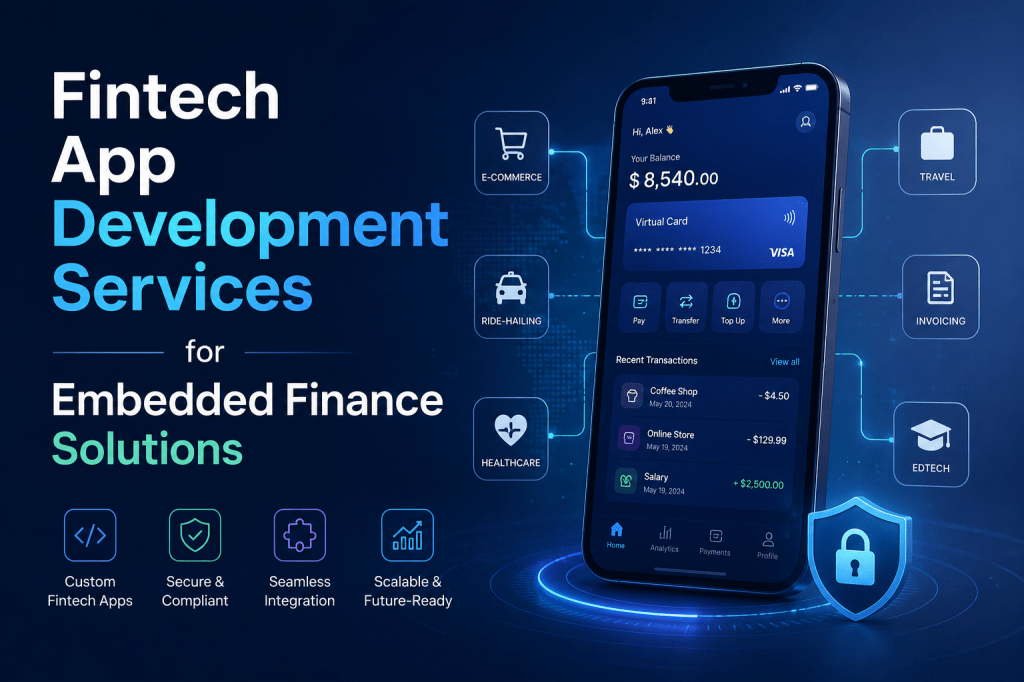
Financial services are no longer confined to banks alone and businesses across every industry are integrating finance directly into their products, which is where embedded finance becomes a transformative force. Companies seeking reliable fintech app development services are building products that allow users to pay, borrow and invest without leaving a platform they already trust. This blog covers what embedded finance truly means, what strong development looks like in practice and why choosing the right partner for this work shapes your product’s long-term success in this fast-moving market.
What Embedded Finance Actually Means for Modern Businesses
Embedded finance is the integration of financial tools payments, lending, insurance directly into non-financial platforms, which removes the friction of redirecting users to third-party services entirely. Businesses using professional fintech app development services are embedding these tools to increase user retention, drive transaction revenue and reduce drop-off at critical checkout or onboarding moments.
Core features embedded finance typically includes:
- In-app wallets that allow users to store and transfer funds without leaving the product
- Buy Now Pay Later modules integrated directly at the point of purchase for higher conversion
- Real-time payment processing with multi-currency support for global user bases
- Insurance and lending widgets embedded into checkout or onboarding flows natively
When financial features live inside the user journey, adoption rates increase meaningfully and customer lifetime value grows accordingly.
Key Capabilities to Look for in Fintech App Development Services
Not every development team understands the compliance, architecture and security demands that come with building financial products, so evaluating capability before committing to a partner matters greatly. A skilled fintech app development services provider brings regulatory awareness, API integration experience and scalable backend architecture to the table from the start.
What capable fintech development teams consistently deliver:
- Open banking API integration that connects your product to licensed financial institutions smoothly
- KYC and AML compliance workflows built into onboarding to meet regulatory requirements at launch
- End-to-end encryption and tokenization of sensitive financial data across all user touchpoints
- Modular architecture that allows financial features to scale independently without disrupting the core product
Strong technical capability and compliance knowledge together form the foundation of any embedded finance product that survives regulatory scrutiny and earns genuine user trust over time.
How a Fintech Mobile App Development Company Approaches Embedded Solutions
A focused fintech mobile app development company does not treat embedded finance as a feature addition but as a structural product decision that touches architecture, design and compliance simultaneously from day one.
Their process typically covers these stages:
- Discovery workshops to map user financial journeys and identify where embedding creates the most measurable value
- API and third-party provider evaluation to select payment rails, banking partners and compliance tooling
- Iterative prototyping that tests embedded financial flows with real users before committing to a full build
- Security audits and penetration testing before any financial feature reaches a production environment
This structured approach reduces rework, surfaces compliance gaps early and ensures the embedded finance layer integrates cleanly with existing product infrastructure, which ultimately saves both time and development budget across the entire project lifecycle.
Choosing Between Fintech App Development Companies
The market has no shortage of fintech app development companies, but genuine embedded finance expertise is concentrated in a smaller group of teams with relevant delivery experience and domain knowledge in financial products.
Criteria that separate strong partners from average ones:
- A verifiable portfolio of embedded finance products already live in regulated markets with measurable outcomes
- In-house compliance consultants who understand PSD2, PCI-DSS and regional data protection laws for your target market
- Transparent development workflows with milestone-based delivery and clear accountability for technical and compliance decisions
- Post-launch support structures that cover security patches, API version updates and regulatory change management
Evaluating partners against these criteria before signing any engagement reduces the risk of building a product that is technically functional but structurally non-compliant in the markets you intend to serve.
Why Your Tech Stack Choices Define Embedded Finance Product Quality
The technology decisions made early in a fintech project determine how well the product handles scale, regulatory updates and third-party integrations in the years following initial launch. Providers of fintech app development services who understand embedded finance recommend stacks proven in financial environments rather than general-purpose frameworks applied to sensitive use cases without modification.
Stack decisions that consistently affect embedded finance quality:
- Microservices architecture that isolates financial logic and allows independent updates without full deployment cycles
- Event-driven systems that process payment and transaction events in real time with full audit trail support
- Cloud infrastructure with multi-region failover to maintain uptime standards required by financial regulators globally
- SDKs and headless APIs that let product teams embed financial features without rebuilding the entire frontend layer
Technology choices made correctly at the start prevent expensive re-architecture at the worst possible time.
What Separates a Reliable Fintech App Development Company
Reliability in this space means more than delivering code on schedule and a dependable fintech app development company demonstrates that reliability through how they handle edge cases, regulatory changes and production incidents that inevitably arise in live financial products.
Markers of a genuinely reliable fintech development partner:
- Incident response protocols defined before launch, not assembled after a production issue surfaces
- Versioned API management that prevents breaking changes from disrupting financial operations for end users
- Regulatory change monitoring services that flag compliance requirements relevant to your product’s active markets
- Clear IP ownership agreements ensuring your embedded finance infrastructure belongs to your business entirely
These qualities are harder to assess in a sales conversation than portfolio work, so asking for case studies from regulated markets provides the clearest signal of genuine reliability.
Final Thoughts
Embedded finance is reshaping how businesses deliver value and companies investing in the right fintech app development services are gaining meaningful advantages in user retention, transaction revenue and product differentiation that generic competitors cannot match quickly. Whether you are evaluating your first embedded finance feature or rebuilding an existing product around financial infrastructure, the partner you choose defines how far and how fast your product can grow, so making that choice with clear criteria, verified expertise and compliance-first thinking is the most important decision your team will make.
 Site Title
Leave a comment